
🌿 Toothache Plant: The Little Flower That Makes Your Mouth Buzz
By The Herb Peddler at Horse-n-Bear Ranch
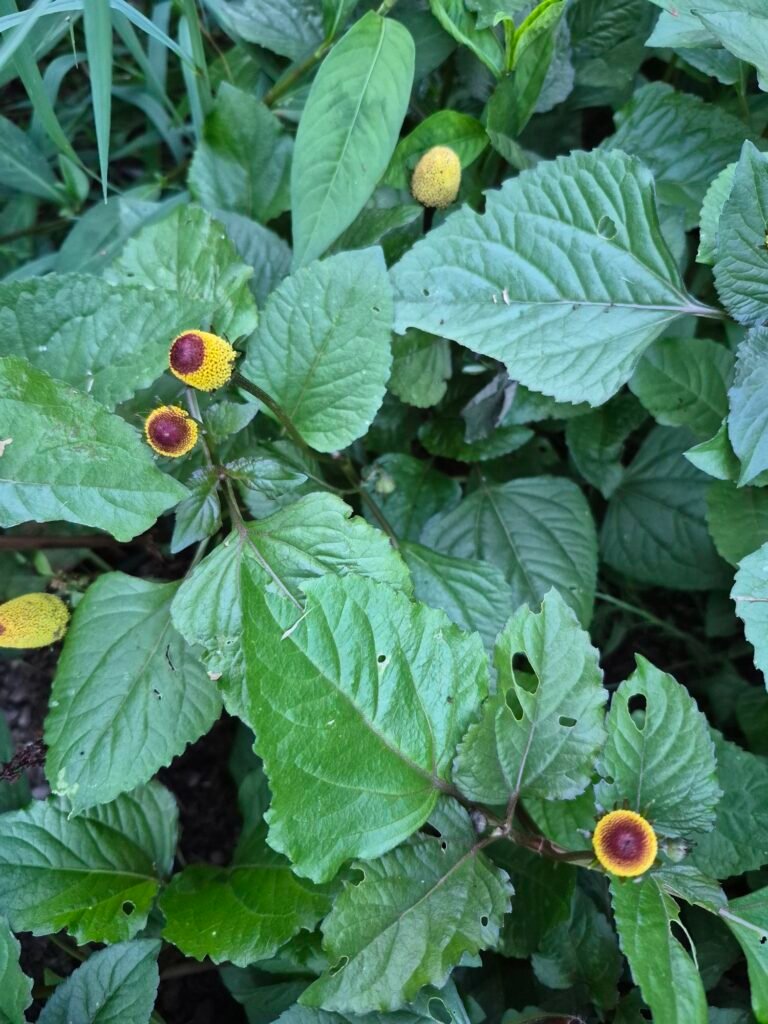
There are herbs that look medicinal.
There are herbs that smell medicinal.
And then there is Toothache Plant—a little yellow flower that looks almost like a miniature pincushion and makes your mouth buzz, tingle, and temporarily go slightly numb when you chew it.
Yep. Really.
And that’s exactly why this unusual little plant has become one of our favorites to grow and share at the farm.
Meet Toothache Plant
Toothache Plant (Acmella oleracea) belongs to the Asteraceae family, the same large plant family that includes familiar herbs such as chamomile and echinacea.
It goes by quite a few names:
- Toothache Plant
- Buzz Buttons
- Electric Daisy
- Paracress
- Spilanthes
You’ll also see older herbal literature using names such as Spilanthes acmella or Spilanthes oleracea. Modern botanical classification recognizes Acmella oleracea as the accepted name.
The plant is native as a cultivated species to southeastern Brazil and has since been introduced and cultivated in many tropical and subtropical regions. It’s an annual herb with distinctive yellow flower heads, often marked with a reddish-brown center.
And those flowers are where the fun begins.
⚡ Why Does Toothache Plant Make Your Mouth Buzz?
This is what makes Toothache Plant so fascinating.
Chew a tiny piece of the fresh flower head and you’ll quickly notice something unusual happening.
First comes a tingling sensation.
Then comes the buzz.
Saliva production increases, and the sensation can progress into a temporary mild numbing effect.
The experience is sometimes described as being a little like a tiny electrical current running through your mouth!
The primary compounds responsible for this characteristic sensation are alkylamides, particularly spilanthol. Researchers have studied spilanthol extensively because of its effects on sensory nerves and saliva production.
And this isn’t just something scientists discovered in a laboratory.
People have been using this remarkable plant traditionally for generations.
🌿 Why Is It Called Toothache Plant?
The common name comes from one of its oldest and best-known traditional uses.
Various traditional herbal practices have used the leaves and flower heads of Acmella species for toothache and mouth discomfort. Historical herbal literature also documents use for sore throats, gum problems, and other oral complaints.
The traditional practice makes a certain amount of sense when you experience the plant yourself.
That strong tingling and numbing sensation isn’t imaginary.
The plant’s compounds interact with sensory pathways in the mouth, producing the characteristic buzzing and temporary numbing sensation.
But there’s an important distinction here: traditional use is not the same thing as proving that an herb will treat a dental condition.
A toothache can have many causes—including decay, infection, an abscess, or an injured tooth. Toothache Plant shouldn’t be considered a substitute for proper dental care.
Think of it as a fascinating piece of traditional herbal knowledge—not a replacement for your dentist.
👅 The “Buzz Button” Experience
One of the most entertaining things about Toothache Plant is that you can experience the herb yourself.
At the market, we’ll sometimes invite people to try a very small piece of the flower.
And then we wait for the reaction.
There’s usually a moment of:
“Huh…”
followed by:
“Whoa!”
The flower produces a distinctive progression:
Tingle → Buzz → Saliva → Mild temporary numbness
The intensity can vary depending on the plant, the flower, and how much is consumed.
If you’re trying it for the first time, a tiny piece is plenty.
And because some people can be sensitive to plants in the daisy family or to strongly stimulating herbs, it’s always wise to start cautiously.
🌼 More Than Just a Toothache Herb
Although Toothache Plant is famous for its traditional use in oral care, that’s not the only reason this plant has attracted attention.
The leaves and flowers have also been used traditionally as food and as an herb in different cultures. Kew’s Plants of the World Online records Acmella oleracea as having uses for both food and medicine.
The fresh leaves have a distinctive flavor, and the flower heads provide that unmistakable tingling sensation.
In other words, this is one of those plants that can be both an herbal curiosity and a culinary curiosity.
🔬 What’s Actually in the Plant?
The compound that gets the most attention is spilanthol, one of the plant’s naturally occurring alkylamides.
Modern research has investigated Acmella oleracea and its constituents for a wide variety of biological activities. Research interest includes its effects on sensory pathways, saliva production, inflammation, microorganisms, and other biological processes.
That’s where herbalism gets particularly interesting.
A plant doesn’t need to be a single “active ingredient.”
A whole plant contains many different compounds working together, and traditional herbalists have worked with those plants long before modern chemistry could identify individual constituents.
Modern science can help us understand why a plant behaves the way it does.
Traditional knowledge helps us understand how people have worked with the plant over generations.
Both perspectives are worth exploring.
🌱 Growing Toothache Plant
Toothache Plant is also a fun addition to the herb garden.
It’s an annual and prefers warm growing conditions. Given enough warmth and sunlight, it can produce an abundance of those distinctive little yellow flower heads.
And honestly, it’s a conversation piece all by itself.
Visitors who see it growing for the first time almost always want to know:
“What IS that?”
Once they learn that the flowers make your mouth buzz, they want to try it.
That’s one of the things I love about growing unusual herbs.
They’re not just plants.
They’re experiences.
🌿 The Herb Peddler’s Take
I think Toothache Plant is a perfect example of why I love herbalism.
It’s easy to walk past a little yellow flower without giving it a second thought.
But look a little closer and suddenly you’re discovering:
🌿 A plant with a fascinating botanical history
🌼 A traditional herbal remedy
⚡ A remarkable sensory experience
🔬 Interesting plant chemistry
🍃 A culinary herb
🌱 And a wonderfully unusual addition to the garden
There’s so much knowledge hiding in the plants around us.
Sometimes you just have to stop, look a little closer…
…and take a bite.
— The Herb Peddler
Horse-n-Bear Ranch
Fort Blackmore, Virginia
⚠️ A Note About Traditional Herbal Use
The information in this article is provided for educational purposes and reflects traditional herbal knowledge and available research. It is not intended to diagnose, treat, cure, or prevent disease. Toothache Plant should not be used to delay appropriate dental care, particularly when tooth pain is severe, persistent, or accompanied by swelling or signs of infection.
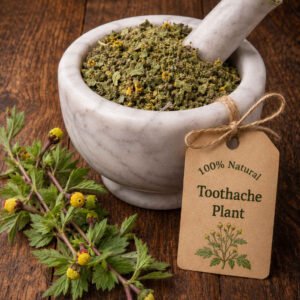
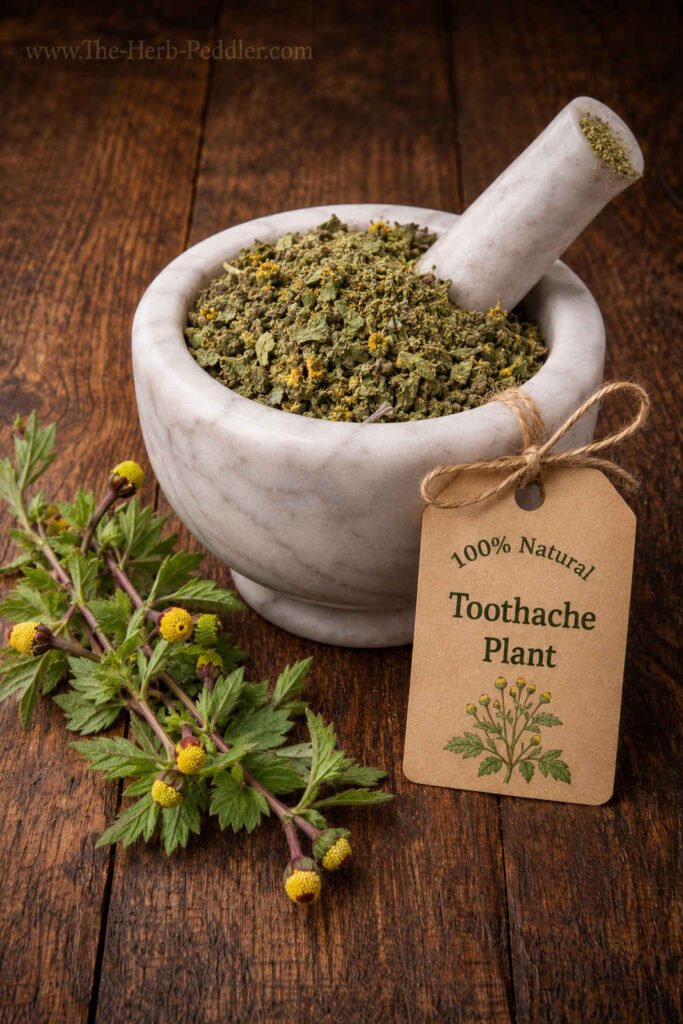
Toothache Plant
Toothache Plant, also known as Spilanthes or “Buzz Buttons,” is a unique herb traditionally used to support oral health and soothe occasional tooth and gum discomfort. The flower heads produce a tingling, numbing sensation that gives this plant its name.